
Enter 2026, a year of struggle
Wow, what a January. You could say 2026 started off on the wrong foot.
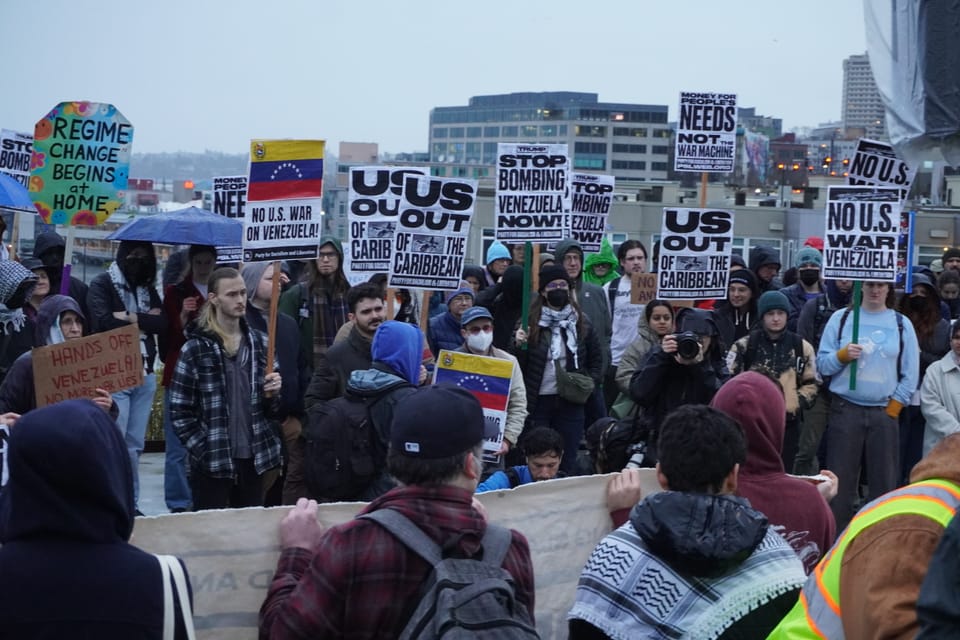
It kicked off with the U.S. illegally abducting Nicolás Maduro, the president of the sovereign state of Venezuela. Then ICE officers extrajudicially killed Keith Porter, Renée Good and Alex Pretti amid the agency’s tyrannical attacks on immigrants. President Donald Trump is also busy creating his own, personally controlled version of the U.N., with Gaza its inaugural victim. And in the newest Epstein files release, we learned in depth how depraved many of the billionaire elites are.
This is just the tip of the iceberg. Reading the news feels disheartening. It’s the car crash you can’t take your eyes off. That’s the point: To “flood the zone,” overload us with information, shock our nervous systems and send us into despair or apathy.
The antidote is to stay focused. When we step back and look analytically, we can see a political window opening up. Resistance to fascist overreach is mounting. It’s time to lock in.
A confluence of factors — ranging from Trump’s erratic leadership to the long-term shifts of geopolitical power back to Asia — creates systemic instability. We are entering a new period of history where things are in flux, and the outcomes remain undetermined.
Browsing recent news bulletins, I saw a few examples that illustrate the cracks in this wave of neo-fascism:
- Hundreds of thousands of Minnesota residents participated in the anti-ICE general strikes on Jan. 23 and 30 — the first U.S. general strike in more than 80 years. Now some labor leaders are calling for a nationwide walkout on May Day.
- At his speech in Davos, Canadian Prime Minister Mark Carney acknowledged global power relations are shaped not by liberal international rules but the U.S.’s hegemonic and bullying policies, echoing what many statespeople of the Global South have said for decades.
- Bad Bunny and Billie Eilish joined a chorus of celebrities in denouncing ICE at the Grammys, suggesting a broader shift in popular sentiment that has even filtered into some elite circles.
These are indications of growing rupture, but do not necessarily portend a positive direction. Discontent tends to be chaotic and is usually channeled to the most well-worn grooves. In the U.S., this can mean turning toward electoralism, discourse politics, peaceful advocacy and individualistic thinking. This isn’t to say any of these are wrong, it just means we should pay attention to what conflict skills are most robustly developed and what strategies the U.S. left has yet to flesh out.
I’ve thought about these topics a lot in my time both covering and participating in social movements, meditating a lot about how best activists and communities can show up to meet the moment. And to be honest, I don’t know. No one has the perfect solution for these times, which are not without precedent but nevertheless far more intense than what many of us are used to.
But I did have some thoughts on where we can maybe start. If our social movements for liberation can keep these four things in mind, they will be more powerful and prepared for what will surely be a tumultuous year.
Think globally: Most of our activism and political work is locally rooted in our own neighborhoods, schools, workplaces, faith organizations and cities. This is natural, since we build power through our relationships. However, we cannot afford to lose sight of the broadest possible picture.
The population of the United States makes up only 4% of humanity. Our social movements must be able to forge alliances with counterparts in other countries. Historically most successful liberation movements have always sought aid from those abroad and exchanged lessons with them.
In even the most granular issues, such as building social housing or creating safer streets, you can find common cause with people around the world. Ultimately, we are all experiencing the same global power structures and fighting the same capitalist class. Finding the international through line helps us stay grounded and moving in the right direction.
Embrace a long trajectory. In 2026, we are very likely to see many mass mobilizations. This could look like increased participation in elections and other civic platforms. Perhaps we’ll have record-breaking protests too. As the reactionary federal administration ramps up its attacks, outrage will simmer, boil over and then explode. In the social media age, it is easier than ever to turn people out to loosely coordinated actions at a moment’s notice.
This is a common axiom, but nonetheless bears repeating: mobilizing is not organizing. Getting folks onto the streets is important and sometimes even vital. But in order to be successful, it must be part of a coherent strategy. Other tactics like boycotts and strikes, which exert direct leverage on specific targets, can sometimes be even more effective.
To build, organize and deploy enough forces to be victorious, movements generally need to recruit a mass base and establish sympathy from a majority of people. There’s a lot of work left to do persuading people, empowering them to speak up and spreading class consciousness among the masses.
Fight on every front. Trump and his reactionary coterie are operating on many levels. Their assaults take the form of executive orders, lawsuits, legislation, media manipulation, police crackdowns, electoral interference, pressure on asset managers and donors, mobilization of fringe and paramilitary groups and many others. They are working not just on the national or local level but also in lockstep with international actors.
We must be equally prepared to deploy any and all necessary tactics and strategies to fight back. From formal electoral politics to the streets, no terrain may be ceded.
As the administration ignores the rule of law, our social movements should not feel constrained by the limits of a legal system rigged against the most vulnerable and marginalized. Proper risk mitigation should be practiced, but the idea that lawful opposition is the only path must be discarded.
Remember revolutionary hope: We need to stay hopeful and believe we can win. It’s worth saying this again and again like a spell. We must visualize what it looks like to not only defeat fascism but also overthrow all the systems of oppression and create a renewed and just world. We have to believe sweet victory is possible in the mortal and material world.
That doesn’t mean we live in some sort of la-la land. Antonio Gramsci summarized it best: "pessimism of the intellect and optimism of the will.” We must remain unflinchingly cogent about the dire realities we face, yet observe when we make progress and score victories, however small they may be. We must develop a mental practice of positive imagination so that even when we feel the most helpless, we do not fall into nihilism.
Maintaining hope means that when we don’t feel hope emotionally, spiritually or in our bones, we can hold it in our intellect. And when we can’t tolerate thinking hopefully, we utter it out loud or scribble it down on a note. Or at least distract ourselves and promise to do so tomorrow. Like Mariame Kaba says, hope is a discipline — it’s not always easy. But it’s possible, and necessary.
End note: I hope you enjoyed this different type of essay. Thank you all for the tremendous support you’ve shown me since I left my job at Real Change. As I ease out of vacation mode, I’m excited to publish the local accountability and social movement reporting you’ve come to know here at Gossip Guy. I’m also excited to share more personal writing, analytical essays and travel diaries with you as well. If you wanna keep up with it all, be sure to subscribe to the newsletter.
Member discussion